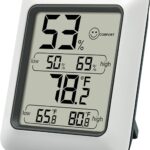
Imagine this: you walk into a room, and instantly feel a wave of comfort wash over you. The ambient air in the room is perfectly balanced, thanks to a sensor that regulates it. As you glance around, you notice a mirror on the wall, reflecting the serene atmosphere of the space. The humidity readings indicate that the air feels just right – not too dry or too damp. This can be determined using a wet bulb and psychrometer, which help measure the climatic conditions. You wonder how the environment is so perfectly balanced. Well, it’s all thanks to humidity measurement tools. Humidity measurement tools, such as hygrometers, psychrometers, and thermometers, are essential for obtaining accurate temperature readings in various environments, whether it’s your home, workplace, or even a laboratory. These psychrometers, hygrometers, thermometers, and humidity meters play a crucial role in monitoring and controlling moisture levels to create comfortable spaces, support industrial processes, and aid scientific research.  Accurate humidity measurement using a hygrometer or psychrometer is more important than you might think. Temperature readings and wet bulb measurements are crucial for accurate results. A hygrometer helps monitor and control air humidity by measuring the amount of water vapor in the air. This is essential for preventing issues like mold growth, equipment damage, and product spoilage. Make sure to regularly check the battery of your hygrometer to ensure accurate readings. By using hygrometers or other humidity measuring devices, such as thermometers, you can keep problems related to water vapor at bay. These devices typically run on battery and provide an accurate display of the humidity levels. Different types of humidity measurement tools, such as hygrometers and thermometers, are available to accurately measure water vapor in various applications. Each tool is designed to suit specific needs and accuracy requirements. From simple wet indicators to advanced thermometers, hygrometers, and humidity meters, there’s an instrument for every need. Understanding the principles behind these model tools empowers you to make informed decisions when choosing the right one for your specific situation. Whether it’s values, display, or thermometers, having a grasp on the fundamentals will help you make the best choice. In the next sections, we’ll dive deeper into the world of humidity measurement tools, such as the hygrometer, and explore their features and benefits in accurately measuring water content in the air. So buckle up as we embark on this journey together to explore the importance of water and how it affects air humidity. With the help of a hygrometer, also known as a humidity meter, we can measure and monitor the levels of moisture in the air.
Importance of Humidity in Various Applications
Humidity in HVAC Systems: Ensuring Comfortable Indoor Environments
Air humidity plays a vital role. HVAC systems, which are responsible for heating, ventilation, and air conditioning, rely on accurate humidity measurements to maintain proper air quality and ensure the right levels of water in the air. The moisture content in the ambient air, as measured by a humidity meter, affects our perception of temperature and comfort. If the humidity levels are too high, we feel hot and sticky; if they’re too low, we experience dryness and discomfort. To achieve optimal conditions, humidity measurement tools are used to monitor and control the moisture content in the air. These HVAC tools enable systems to adjust the level of air humidity by regulating the amount of water vapor present in indoor environments. By maintaining an ideal balance of humidity, these systems ensure that occupants can enjoy a pleasant atmosphere all year round.
Precise Humidity Control in Pharmaceutical Manufacturing
In pharmaceutical manufacturing, precise humidity control is crucial for maintaining product stability and efficacy. Many medications are sensitive to changes in air humidity, which can impact their chemical composition and effectiveness. Therefore, it is essential to monitor and regulate the humidity within pharmaceutical production facilities. Humidity measurement tools play a critical role in this process by providing accurate readings of moisture content. By closely monitoring the air humidity and water vapor content during manufacturing processes such as tablet compression or liquid formulation, pharmaceutical companies can ensure consistent quality across their products. This helps prevent degradation or alteration caused by excessive moisture or dry conditions, including air humidity.
Optimizing Crop Production and Preventing Diseases in Agriculture
Agricultural operations heavily rely on humidity measurements to optimize crop production and prevent diseases. Different crops have specific requirements. Monitoring air humidity, among other factors, allows farmers to make informed decisions about irrigation schedules and pest management strategies. For example, greenhouses provide controlled environments where temperature and humidity can be regulated precisely. By using humidity measurement tools inside greenhouses, farmers can create the ideal conditions for plant growth. Monitoring humidity levels in open fields helps farmers determine when irrigation is necessary to prevent drought stress or waterlogging.
Preserving Delicate Artifacts in Museums and Art Galleries
Museums and art galleries face the challenge of preserving delicate artifacts from deterioration or damage. Humidity control plays a crucial role in this preservation process. Fluctuations in air humidity can cause irreversible harm to paintings, sculptures, documents, and other valuable items. Humidity measurement tools are employed to monitor and maintain stable environmental conditions within these cultural institutions. By carefully controlling the ambient humidity, curators can prevent the warping, cracking, or mold growth that can occur when artworks are exposed to excessively dry or humid environments. This ensures that future generations can continue to appreciate these treasures for years to come, while also maintaining optimal air humidity.
Preventing Electrostatic Discharge and Equipment Malfunctions in Data Centers
Data centers house critical computer systems that require precise environmental conditions for optimal performance. Humidity measurement tools play a vital role in preventing electrostatic discharge (ESD) and equipment malfunctions within these facilities. High humidity levels increase the risk of ESD, which can cause irreparable damage to sensitive electronic components. On the other hand, low humidity can lead to static electricity buildup and subsequent malfunctions.
Types of Humidity Measurement Tools
Psychrometers: Comparing Temperature Readings
Psychrometers are an essential tool for measuring relative humidity. These nifty devices work by comparing the wet-bulb temperature with dry-bulb temperature readings. But how does it all come together? Well, let me break it down for you. The wet-bulb temperature is determined by wrapping a moistened wick around the bulb of a thermometer and exposing it to the air. As moisture evaporates from the wick, it cools down, causing the wet-bulb temperature to drop. On the other hand, the dry-bulb temperature is simply measured using a regular thermometer. By comparing these two temperatures, psychrometers can calculate relative humidity accurately. The difference between the wet-bulb and dry-bulb temperatures indicates how much moisture is present in the air. This measurement helps us understand whether conditions are more humid or drier.
Capacitive Sensors: Electrical Changes Reveal Humidity Levels
Capacitive sensors take a different approach. Instead of relying on temperatures, they use changes in electrical capacitance to determine relative humidity more precisely. Now, you might be wondering what electrical capacitance even means! Think of it as a measure of an object’s ability to store an electric charge. In capacitive sensors, this ability changes based on the amount of moisture in the air. These sensors consist of two conductive plates separated by a dielectric material that absorbs water vapor from its surroundings. As moisture is absorbed or released by this material, its dielectric constant changes accordingly. This alteration affects the capacitance between the plates and allows capacitive sensors to gauge relative humidity levels with great accuracy.
Resistive Sensors: Measuring Resistance for Moisture Detection
Resistive sensors provide yet another method for measuring humidity levels accurately. Instead of focusing on electrical capacitance, they rely on changes in electrical resistance caused by moisture absorption or desorption. Imagine a thin film of a moisture-sensitive material placed between two electrodes. As the surrounding air becomes more humid, this film absorbs moisture and expands. This expansion leads to an increase in electrical conductivity and a decrease in resistance. By measuring the resistance across these electrodes, resistive sensors can determine the relative humidity present in the environment. These sensors are commonly used in various applications, such as weather stations, HVAC systems, and even for monitoring moisture levels in soil.
Dew Point Hygrometers: Calculating Absolute Humidity
Dew point hygrometers take a different approach to measure humidity accurately. Instead of focusing on relative humidity, they calculate absolute humidity based on the temperature at which condensation occurs. You might have noticed dew forming on grass or windows during certain weather conditions. This happens when the temperature drops to a point where the air can no longer hold all its moisture, leading to condensation. Dew point hygrometers work by cooling down a mirror until dew forms on its surface. By measuring this temperature at which condensation begins, these hygrometers can calculate absolute humidity accurately. These devices are particularly useful in industrial settings where precise control over humidity levels is crucial. They help ensure that conditions remain within specific limits to prevent issues like corrosion or mold growth.
How to Choose the Best Humidity Measurement Tool
Consider Accuracy Level
Accuracy is crucial when selecting a humidity measurement tool. Different applications have varying sensitivities to moisture variations, so it’s essential to choose a tool that meets your specific requirements. Determine the level of accuracy needed based on the sensitivity of your application. For instance, if you’re working in a laboratory setting where precise measurements are necessary for experiments or research, opt for a high-accuracy tool. On the other hand, if you’re monitoring humidity levels in a general environment such as an office or home, a slightly lower accuracy level may suffice.
Evaluate Operating Range
The operating range of each humidity measurement tool should be carefully evaluated. Some tools may have limitations at extreme temperatures or high humidities. If your application involves working in harsh environments with extreme temperature fluctuations or high humidity levels, it’s important to choose a tool that can withstand these conditions without compromising accuracy. Look for tools specifically designed to operate within the range required by your application.
Assess Additional Factors
In addition to accuracy and operating range, several other factors should be considered when choosing a humidity measurement tool:
- Response Time: Depending on your application, response time may be critical. Some tools provide real-time readings almost instantly, while others may require more time to stabilize and provide accurate results.
- Calibration Requirements: Regular calibration ensures the continued accuracy of humidity measurement tools. Consider whether the selected tool requires frequent calibration and whether it can be easily calibrated in-house or if professional calibration services are necessary.
- Maintenance Needs: Different tools vary in terms of maintenance requirements. Some may require periodic cleaning or replacement of components such as sensors or filters. Take into account the maintenance needs and factor them into your decision-making process.
- Cost-effectiveness: Budget is always an important consideration when choosing any equipment or instrument. Compare different options based on their features and cost-effectiveness. While it’s tempting to opt for the cheapest option, remember that quality and accuracy should not be compromised.
Determine Additional Features
Depending on your specific needs, you may want to consider additional features in a humidity measurement tool:
- Data Logging Capabilities: If you require continuous monitoring or data analysis over an extended period, look for tools with built-in data logging capabilities. These tools can store and record humidity readings at regular intervals, allowing you to analyze trends and patterns.
- Wireless Connectivity: In today’s connected world, wireless connectivity can greatly enhance convenience and ease of use. Some humidity measurement tools offer wireless connectivity options, enabling seamless data transfer to other devices such as smartphones or computers.
Consider whether these additional features align with your requirements and if they would provide added value to your application.
Consult Industry Standards
To ensure compliance with specific regulations or quality control requirements, consult industry standards and guidelines when selecting a humidity measurement tool. Different industries may have specific standards for measuring humidity in certain environments. By adhering to these standards, you can ensure that your measurements are accurate and reliable.
Understanding Relative Humidity & Temperature Meters
Relative humidity meters, also known as humidity measurement tools or humidity meters, are essential devices used to measure the amount of moisture present in the air compared to its maximum capacity at a given temperature. These meters play a crucial role in various fields such as meteorology, HVAC (Heating, Ventilation, and Air Conditioning) systems, industrial processes, and scientific research. Humidity readings are important because they provide valuable insights into the comfort level of an environment and can help prevent issues like mold growth or damage to sensitive equipment. To accurately measure relative humidity, these meters often include built-in temperature sensors that allow for simultaneous readings of both parameters. One type of relative humidity meter is called a psychrometer. This handheld device consists of two thermometers—one wet bulb thermometer covered with a moistened wick and one dry bulb thermometer. By comparing the temperature difference between these two thermometers, the relative humidity can be determined using a psychrometric chart or calculation. In addition to measuring relative humidity and ambient temperature, many modern humidity meters offer additional features to enhance their functionality. Some models have dew point calculation capabilities, which determine the temperature at which water vapor begins to condense on surfaces. This information is particularly useful in applications like building insulation assessment or predicting condensation problems. Another feature found in certain advanced models is the ability to measure wet bulb temperature. Wet bulb temperature represents the lowest temperature achievable through evaporative cooling and can be used to assess heat stress conditions or evaluate cooling efficiency in industrial processes. Furthermore, some humidity meters come equipped with data logging capabilities that allow for continuous monitoring over time. This feature enables users to track changes in environmental conditions and identify trends or potential issues that may require attention. Portable relative humidity meters are commonly used for field measurements and troubleshooting HVAC systems. Their compact size and ease of use make them ideal for on-site assessments where quick measurements are required. Whether it’s determining the humidity levels in a home, office, or outdoor environment, these meters provide valuable information for maintaining optimal conditions. On the other hand, laboratory-grade humidity meters offer higher accuracy and precision suitable for scientific research and industrial applications. These instruments undergo rigorous calibration procedures to ensure reliable and repeatable measurements. They often come with additional features such as multiple data points, advanced data analysis software, and compatibility with external sensors for specialized applications.
Exploring Hygrometers: Hair Tension, Classical, and Chilled Mirror Dew Point
Hair Tension Hygrometers: Unlocking the Secrets of Humidity with Human or Animal Hair
Hair tension hygrometers are a fascinating tool that harnesses the moisture absorption properties of human or animal hair to determine relative humidity levels. It’s almost like having a mini meteorologist right at your fingertips! These hygrometers work by measuring the changes in hair length as it absorbs or releases moisture from the surrounding air. Imagine this: when the air is dry, the hair shrinks, and when it’s humid, the hair expands. This expansion and contraction are directly related to the moisture content in the air. By carefully observing these changes in hair length, you can accurately gauge the relative humidity. One of the advantages of using hair tension hygrometers is their simplicity. They don’t require any fancy equipment or calibration processes. Plus, they are relatively inexpensive compared to other types of hygrometers on the market. However, keep in mind that they may not provide precise measurements like other high-end devices.
Classical Hygrometers: Unveiling Moisture Content through Material Response
Classical hygrometers take a different approach to measure humidity levels. Instead of relying on human or animal hair, these ingenious devices use specific materials that expand or contract in response to changes in moisture content. Picture this: when there’s more moisture present in the air, certain materials tend to absorb it and expand accordingly. On the flip side, if there’s less moisture around, these materials contract due to dehydration. By carefully monitoring these material responses, classical hygrometers give us valuable insights into relative humidity levels. The beauty of classical hygrometers lies in their versatility. They come in various forms such as psychrometers (which use wet bulb and dry bulb thermometers), and they can be used in a wide range of environments. Whether you want to measure humidity in your home, office, or even research laboratories, classical hygrometers have got you covered. However, it’s important to note that classical hygrometers may require periodic calibration to maintain accuracy. Their response time might not be as quick as other modern alternatives. But hey, sometimes good things take a little longer!
Chilled Mirror Dew Point Hygrometers: Cooling Down for Precise Humidity Measurements
Now let’s dive into the world of chilled mirror dew point hygrometers. These cutting-edge devices take humidity measurement to the next level by utilizing the concept of dew point temperature. They work by cooling a surface until condensation forms on it, and then measuring the temperature at which this occurs. Imagine this scenario: when the air is saturated with moisture and reaches its dew point temperature, water droplets start forming on surfaces. By carefully controlling the cooling process and monitoring the temperature at which condensation appears, chilled mirror dew point hygrometers can provide highly accurate readings of relative humidity. The greatest advantage of using these high-tech hygrometers is their exceptional accuracy. They deliver precise measurements even at extremely low levels of humidity. This makes them particularly useful in critical applications where maintaining specific climatic conditions is crucial.
Calibration Standards for Accurate Humidity Measurement
Calibration standards play a crucial role in ensuring that humidity measurement tools provide accurate and reliable readings over time. By following established calibration procedures, you can maintain the precision and integrity of your measurements. Let’s dive into the importance of calibration standards and how they contribute to accurate humidity measurement.
Establishing Traceability Chains for Consistency
National metrology institutes are responsible for establishing traceability chains that help maintain consistency across different calibration laboratories worldwide. These institutes set the primary standards for humidity measurement, which serve as reference instruments with known accuracies. These reference instruments are used to calibrate other devices, ensuring that their measured values align with the accepted standard. By having a well-defined traceability chain, it becomes possible to compare measurements made by different instruments and laboratories. This ensures that regardless of where or when a humidity measurement is taken, there is confidence in its accuracy and reliability.
Following Recommended Calibration Intervals
Regular calibration intervals should be followed based on manufacturer recommendations or industry-specific requirements. The frequency of calibration depends on various factors such as the instrument’s stability, intended use, environmental conditions, and industry regulations. For example, if you work in an industry where maintaining precise humidity levels is critical—such as pharmaceutical manufacturing or semiconductor production—you may need more frequent calibrations to ensure accuracy. On the other hand, industries with less stringent requirements may follow longer calibration intervals. It is essential to adhere to these recommended intervals to avoid potential inaccuracies in your measurements over time. Neglecting regular calibrations can lead to deviations from accurate readings, impacting product quality or process efficiency.
Proper Handling and Storage of Calibration Standards
To preserve the integrity of calibration standards, proper handling, storage, and transportation conditions must be maintained. Any mishandling or exposure to unfavorable environments can compromise their accuracy. Calibration standards often come with specific instructions regarding their storage temperature range and protection from external factors such as dust or moisture. Following these guidelines ensures that the standards remain in optimal condition and continue to provide accurate reference points for calibration. It is crucial to handle calibration standards with care during transportation. Vibrations or sudden movements can affect their accuracy. Using appropriate protective cases or packaging materials can help mitigate potential risks during transit.
The Impact of Choosing the Right Humidity Measurement Tool
We have also delved into the factors to consider when choosing the best humidity measurement tool for your needs and provided insights into relative humidity and temperature meters, as well as hygrometers such as hair tension, classical, and chilled mirror dew point. By understanding the significance of accurate humidity measurement and selecting the right tool, you can ensure optimal performance and reliability in your specific application. Whether you are monitoring humidity levels in a laboratory, manufacturing facility, or even your home, investing in a high-quality humidity measurement tool is crucial. So don’t settle for guesswork or subpar equipment – take control of your environment with precision measurements that deliver accurate results.
FAQs:
What is the difference between relative humidity and absolute humidity?
Relative humidity measures how much moisture is present in the air compared to its maximum capacity at a given temperature. It is expressed as a percentage. Absolute humidity, on the other hand, measures the actual amount of moisture present in a given volume of air. It is typically expressed in grams per cubic meter (g/m³).
How often should I calibrate my humidity measurement tool?
The frequency of calibration depends on several factors such as usage conditions and industry standards. In general, it is recommended to calibrate your instrument annually or according to manufacturer guidelines. However, certain industries may require more frequent calibration to meet regulatory requirements.
Can I use a temperature meter to measure humidity?
No, a temperature meter alone cannot accurately measure humidity. While temperature can provide some indication of moisture content in certain situations (e.g., condensation), dedicated humidity measurement tools are necessary for precise readings.
Are there portable options available for measuring humidity?
Yes, there are portable options available for measuring humidity such as handheld hygrometers. These compact devices are convenient for on-the-go measurements and offer flexibility in various environments.
How do I know if my humidity measurement tool is accurate?
To ensure accuracy, it is essential to regularly calibrate your humidity measurement tool using traceable standards. Comparing readings from multiple instruments or cross-checking with other reliable sources can help verify the accuracy of your measurements.