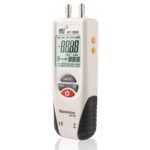
A gas pressure manometer should be chosen for a defined appliance, test point, pressure range and procedure. A gauge that simply displays inches of water column is not automatically suitable for every fuel gas, installation or pressure test.
This guide explains the important differences between analogue gauges and digital differential manometers, the ranges and fittings to check, and the safety questions that should be resolved before an instrument is connected.
Safety first: gas work is regulated and can create fire, explosion and carbon-monoxide hazards. In Great Britain, work on domestic gas appliances must be performed by a suitably qualified Gas Safe registered engineer. Elsewhere, follow the applicable law, licensing rules, appliance instructions and approved procedure. This page is equipment-selection information, not permission or instruction to undertake gas work.
Quick selection guide
| Application | Useful instrument type | What to verify |
|---|---|---|
| Appliance inlet or manifold pressure | Low-pressure gauge or digital manometer approved for the intended gas | Specified range, resolution, gas compatibility, test-point adapter and appliance procedure |
| Compare two pressure points | Two-port differential manometer | P1, P2 and P1–P2 modes, port pressure limits and correct hose arrangement |
| HVAC static pressure or filter drop | Low-pressure differential manometer | Fine resolution near zero, suitable probes and a range matched to duct pressure |
| Timed pressure-drop work | Digital manometer with logging, timer or app workflow | Approved test method, stable zero, data retention and current device compatibility |
| Simple field indication | Analogue dial or fluid-column manometer where the procedure permits it | Orientation, zero adjustment, readable scale, hose condition and overpressure protection |
What a gas pressure manometer measures
A manometer measures pressure relative to another reference. A single-port reading usually compares the connected pressure with ambient atmospheric pressure. A dual-port instrument can also compare two connected points and display their difference.
Gas appliance and HVAC measurements are often relatively low. Common units include inches of water column (inH₂O or inWC), millibars (mbar), hectopascals (hPa), pascals (Pa), kilopascals (kPa) and pounds per square inch (psi). Unit conversion does not make an unsuitable sensor appropriate: the usable range, accuracy and resolution still have to match the job.
Range, resolution and accuracy
Range is the pressure span the instrument can accept and display. Resolution is the smallest displayed change. Accuracy describes how closely a reading is expected to agree with the stated reference conditions.
A very wide range can be useful across several applications, but it may not provide the best practical detail close to zero. Conversely, a fine low-pressure instrument can be damaged or produce an over-range indication if it is connected to pressure beyond its rating. Check both the normal measurement range and any stated maximum static or overpressure limit.
When comparing percentage-of-full-scale specifications, remember that the stated error is based on the instrument’s full range rather than the displayed reading. For low readings, a model with a suitable low-range accuracy statement may be preferable to one promoted mainly by a large maximum range.
Analogue versus digital manometers
Analogue gauges
An analogue dial or fluid-column manometer can offer a direct, battery-free indication. It may be adequate where the approved procedure calls for a simple range and the scale is easy to read. Check orientation, zero adjustment, parallax, scale increments and the condition of the hose and fittings.
Digital manometers
Digital instruments can provide multiple units, a backlit display, min/max/average functions and direct differential readings. Some connect to a phone or tablet for timed tests and reports. They still require correct zeroing, suitable media, compatible hoses and observation of pressure limits.
For a broader explanation of pressure modes and instrument features, see our digital manometer buying guide.
Current professional options
| Model | Manufacturer-stated capability | Best fit | Important check |
|---|---|---|---|
| Klein Tools ET180 | Two-port air and gas pressure measurement; ±60 inH₂O range; eleven selectable units | General HVAC pressure and differential checks | Full-scale accuracy, hose/test-point compatibility and intended gas procedure |
| Fieldpiece SDMN5 | Gas, static and differential pressure; ±60 inWC range; 0.01 inWC low-pressure resolution mode | HVACR field service using dry, non-corrosive gases | Media compatibility, included adapters and the procedure’s required accuracy |
| Testo 510i | Smartphone-operated differential pressure instrument for gas flow, static pressure and pressure-drop work | Technicians who value app-based timed readings and reports | Current phone/app compatibility, range, hose set and approved use |
These examples cover different workflows rather than forming a universal ranking. The correct choice is the instrument that meets the appliance or system procedure and the user’s regulatory and competence requirements.
Seven checks before buying
- Define the pressure test. Identify whether the task involves inlet pressure, manifold pressure, differential pressure, static pressure or a formal pressure-drop test.
- Use the specified range. Start with the appliance, system or approved procedure—not a retailer’s general description.
- Confirm compatible media. Some instruments are restricted to air or dry, non-corrosive gases.
- Check ports, hose and fittings. Diameter, material and adapter type must suit the instrument and test point without improvised connections.
- Review accuracy and resolution. Check the complete specification across the readings that matter.
- Plan calibration and records. Professional work may require traceable calibration, a defined check interval and retained results.
- Confirm legal competence. Instrument ownership does not qualify a person to work on regulated gas systems.
Safe measurement workflow
A qualified technician should follow the current appliance or system instructions and the applicable approved procedure. At a high level, that normally means identifying the specified test point and target value, checking the instrument and hoses, zeroing the manometer under the conditions required by its manual, making the approved connection, obtaining and recording a stable reading, and correctly reinstating and checking the system afterwards.
The detailed sequence, isolation requirements, operating state and permissible pressure loss depend on the installation. Do not substitute a generic online sequence for manufacturer instructions, local regulations or professional training.
Common buying mistakes
- Choosing by display units while ignoring the actual pressure range.
- Assuming every hose and barb is suitable for fuel gas or the test point.
- Using a wide-range instrument without checking useful accuracy near the expected reading.
- Confusing pressure measurement with gas-leak detection or combustion analysis.
- Relying on a phone app without checking operating-system and Bluetooth requirements.
- Treating automatic zero or hold functions as a substitute for an approved test procedure.
- Buying an instrument without access to calibration, replacement hoses and suitable adapters.
Frequently asked questions
Is a gas manometer the same as a gas-leak detector?
No. A manometer measures pressure. A combustible-gas detector responds to a target gas in the surrounding atmosphere. Neither instrument automatically replaces the other.
Is mbar the same as hPa?
For practical pressure conversion, 1 mbar equals 1 hPa. Use the unit and rounding specified by the relevant procedure.
Do I need one port or two?
One port is sufficient for many gauge-pressure readings relative to atmosphere. Two ports are needed when the procedure requires a direct comparison between two pressure points.
Can a manometer be used on any gas appliance?
No. Suitability depends on the instrument’s media statement, pressure limits, fittings and the appliance-specific procedure, as well as the operator’s legal competence.
Final recommendation
Start with the required test and expected pressure—not with a brand or headline range. For varied HVAC work, a two-port digital manometer with useful low-pressure resolution is usually the most flexible format. For regulated gas-appliance work, the decisive factors are approved procedure, suitable fittings, calibration and a properly qualified operator.
How this guide was prepared
This is a specification-led selection guide, not a hands-on comparison. Product functions were checked against current manufacturer pages on 2 September 2026. Verify the current model, manual, included hoses and regional requirements before purchase or use.